Research
Interests
Primary vs.
secondary
analcime: A
new leucitophy dike from the Kaiserstuhl volcanic complex
Research
Collaboratores:
Dipl. Geol. Simon Spürgin, Hauri Mineralstoffwerk,
Bötzingen, Germany
Joachim Hörth, Bühl, Germany
| A
new leucitophyre dike (phonolitic leucitite), which are very rare in
the Kaiserstuhl, was found at Strümpfekopf near the village of
Bickensohl. Beside this locality, only four leucitophyre descriptions
are confirmed during the last 200 years of research; one of them the
well-known dike from Eichberg (Oberrotweil). The dike at
Strümpfekopf is hosted by a 16,2 million years old,
medium-grained
essexite and therefore belongs to the younger products of
volcanism in the Kaiserstuhl. The Mg-value (0.2) indicates considerable
fractionation. The dike contains 42.4 vol-% phenocrysts in very
fine-grained to vitreous matrix, essentially leucite >1.4 mm and
a
second leucite population of 0.2-0.6 mm. Additional phenoctyst phases
are sanidine, aegirine-augite, melanite, apatite and accessories
(magnetite, biotite, calcite). Leucite is completely decomposed to
analcime, sanidine is also heavily altered. Different observations
(e.g. shape and inclusions in analcime, mineral chemistry, cracking,
rock alteration) confirm the secondary origin of analcime pseudomorphs
after primay magmatic leucite. Reference: Spürgin S., Weisenberger T. & Hörth J. (2008) Das Leucitophyrvorkommen vom Strümpfekopf im Kaiserstuhl – eine historische und mineralogische Betrachtung. Berichte der Naturforschenden Gesellschaft zu Freiburg i. Br. 98, 221-244 |
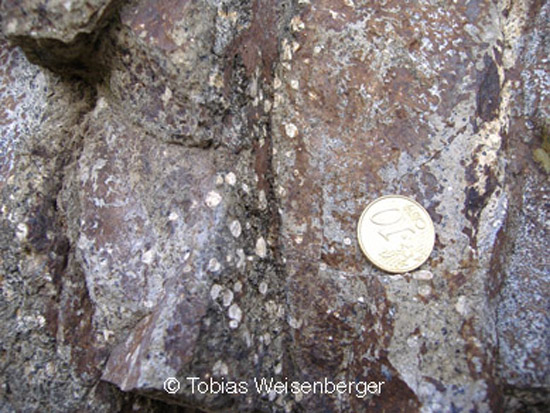 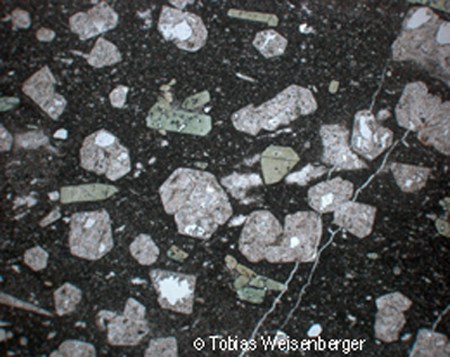 Fig. 2: Thin section potograph under plane polarized light. Euhedral analcime and augite crystals. Image width 3.7 mm |
