Research
Interests
Zeolite
facies mineralisation in the Hvalfjördur area, Iceland
Research
Collaboratore:
Dr. Rune Selbekk, Natural Museum Oslo, Norway
| The
Hvalfjördur area, 30 km north of Iceland´s capital
Reykjavik, belongs to the sequence of late Tertiary to early Quaternary
flood basalts with minor interlayer of hyaloclastites and rhyolites.
Rutten 1958). The basalts are affected by a low temperature zeolite
facies metamorphism, caused by the burial of the lava succession and
higher heat flow influenced by the Laxárvogur and the
Hvalfjördur located central volcano (Weisenberger &
Selbekk 2009). Low-grade zeolite facies metamorphism of basaltic lavas
in the Hvalfjördur field area results in two distinct mineral
paragenesis that can be correlated to events in the burial and
hydrothermal history of the lava pile. Stage 1a marks near surface
alteration in which celadonite and silica were precipitated along
primary pores. During burial, hydrolysis of olivine and glass led to
the formation of mixed layers chlorite/smectite clays. The chlorite
content of stage 1b precipitation increases with increasing burial
depth, respectively temperature. Stage 2 occurred after burial and is
marked by the zeolite mineralisation, caused by higher heat flow, from
the Laxárvogur central volcano. Altogether eleven different
zeolites were found in the Hvalfjördur area: analcime,
chabazite, epistilbite, heulandite, laumontite, levyne, mesolite,
stilbite, stellerite, thomsonite and yugawaralite Selbekk &
Weisenberger 2005, Weisenberger & Selbekk 2009). Based on the
work done by Walker (1960), zeolites were grouped into zeolite zone. In
total three separate depth and temperature-controlled
“zeolite zones” are described in the
Hvalfjördur area: the upper chabazite/thomsonite zone, the
middle mesolite zone and the lowest laumontite zone. The mineralisation
temperature for zeolites increases from the upper chabazite/thomsonite
zone to the lower laumontite zone. Empirical correlation between the
depth distribution of zeolite zone and the temperatures of formation of
zeolites in the geothermal system, a geothermal gradient of
133°C/km can be estimated, usual for central volcanoes. This
indicate the occurrence of a Laxárvogur central volcano,
which can be supported by geochemistry of volcanic rocks and
tectonic features in the Hvalfjördur area. References: Rutten M.G. (1958) Geological reconnaissance of the Esja-Hvalfell-Armannsfell area, southwestern Iceland. Verhandelingen van het Koninklijk Nederlands Geologisch-Mijnbouwkundig Genootschap, Geologische Seris XVII, 219-298 Walker G.P.L. (1960) Zeolite zones and dike distribution in relation to the structure of the basalts of eastern Iceland. Journal of Geology 68, 515-528 Selbekk R.S. & Weisenberger T. (2005) Stellerite from the Hvalfjördur area, Iceland. Jökull 55, 49-52 Weisenberger T. & Selbekk R.S. (2009) Multi-stage zeolite facies mineralization in the Hvalfjördur area, Iceland. International Journal of Earth Sciences, 98, 985-999 (pdf) |
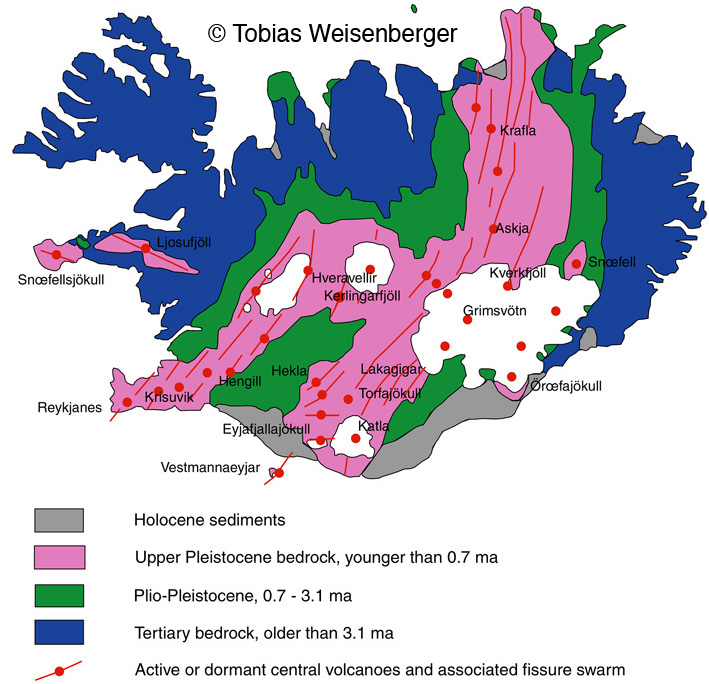 Fig. 1: Geology of Iceland 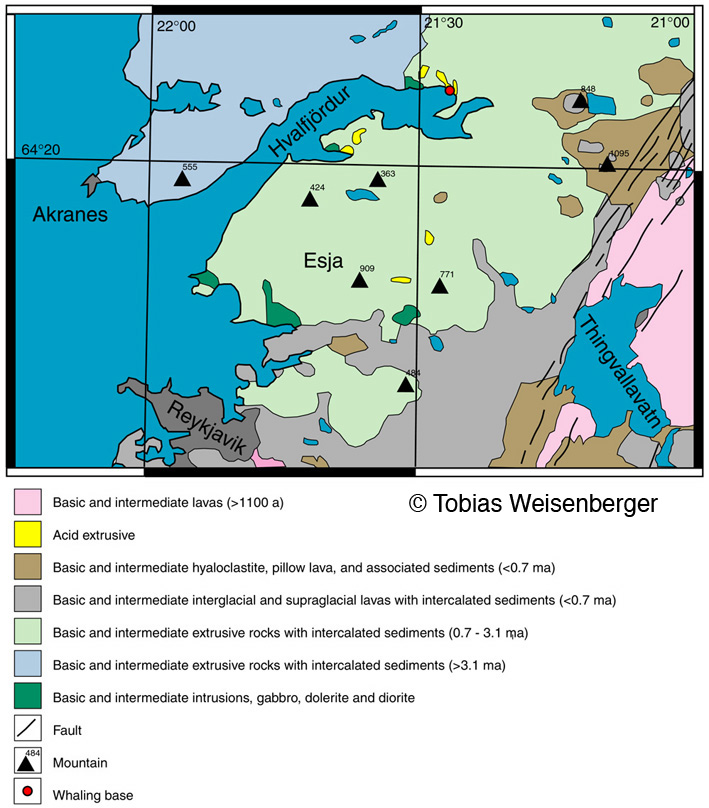 Fig. 2: Simplified geological map of the Hvalfjördur area 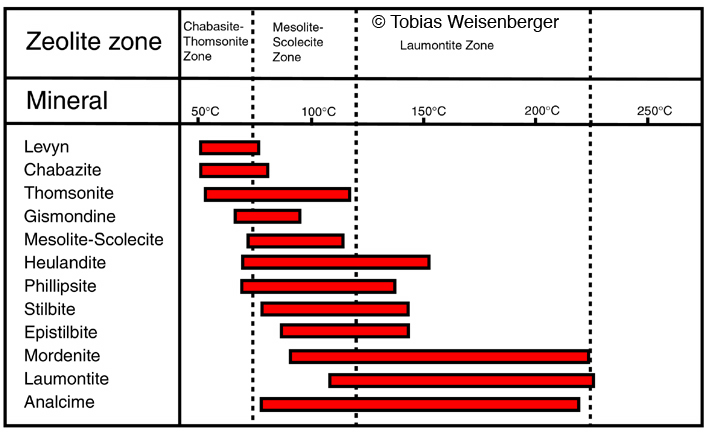 Fig. 3: Zeolite stability 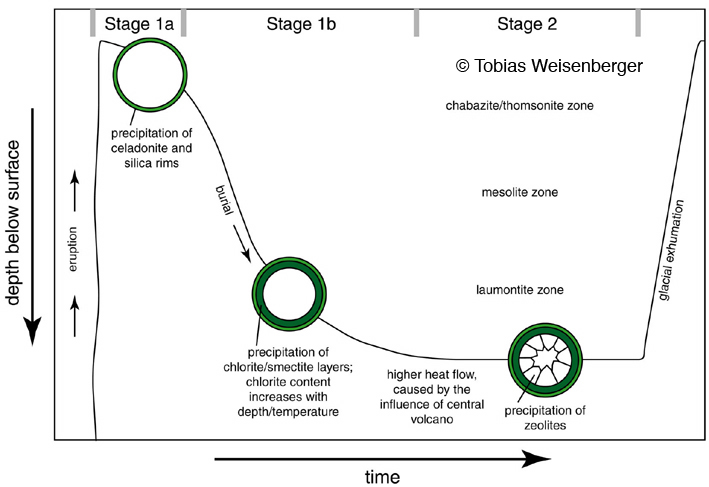 Fig. 4: Spatial and temporal development of pore-filling mineral assemblages in the Hvalfjördur area. The vertical axis depicts depth below land surface at the time of each event depicted in the figure. Time elapsed after eruption increases to the right. No scales are implied on the axis |
